29 de April de 2026

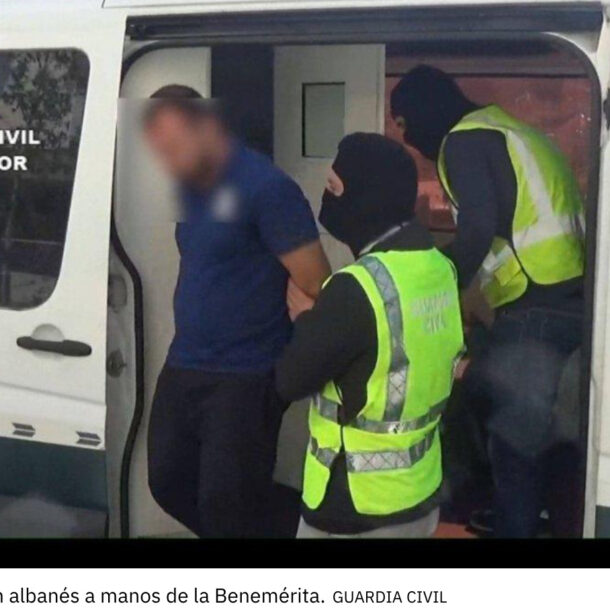
Five other arrestees were released by the Civil Guard after dismantling a network in Vega Baja and l’Alacantí accused of stealing 15 vehicles that were manipulated to send them abroad.
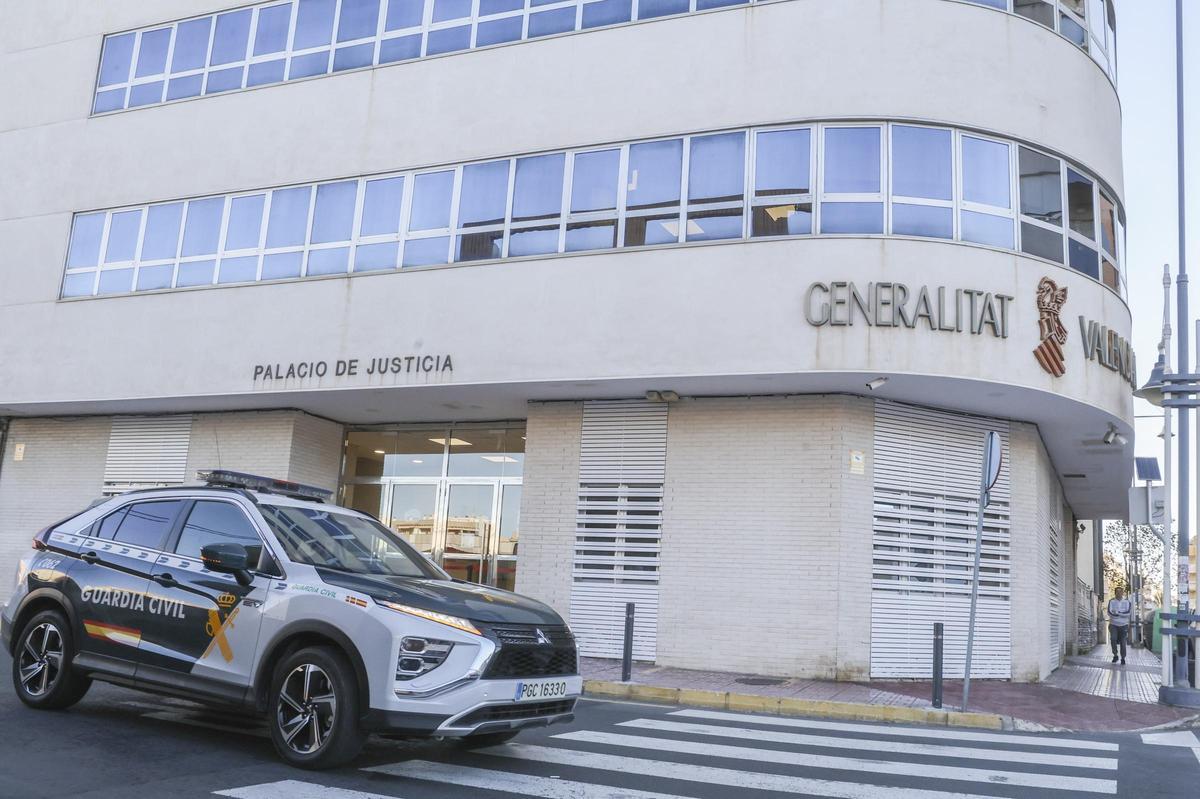
File image of a Civil Guard vehicle in the courts of Torrevieja. / PILAR CORTES
A court in Torrevieja agreed last Friday to the provisional release without bail for eleven arrested by the Civil Guard as members of an organized gang of vehicle theft and drug trafficking dismantled in Vega Baja and l’Alacantí after having been brought to justice, most of them, outside the legal period of 72 hours from their arrest.
The detainees, several of them defended by lawyers Francisco Miguel Galiana Botella, Aitor Esteban Gallastegui and Enrique Giménez Aznar, attended a prison appearance on Friday in Plaza 2 of the Instruction Section of the Court of Instance of Torrevieja and when everything pointed to the imprisonment of those involved, there was a surprise.
Several lawyers reported on the request of the Prosecutor’s Office for the detainees to be imprisoned and opposed the imprisonment of their clients for having been brought to justice outside the legal period of 72 hours, while the lawyer Francisco Galiana, who also alleged this irregularity, delayed his report and demanded that the magistrate previously carry out a test so that the judicial lawyers who attended the searches could certify what time these inspections began and if those arrested were handcuffed at that time. All this to show that the deprivation of liberty began between six and six thirty in the morning last Tuesday, the period in which the searches began, and the detainees were brought to justice at half past seven in the morning last Friday.
The Civil Guard carried out the reading of rights as detainees to those involved at nine in the morning, but the defenses alleged that the deprivation of liberty began at the beginning of the searches and that is the time that must be taken into account to compute the period of 72 hours from the arrest.
The prison appearance was suspended and shortly afterwards the magistrate issued a lengthy order granting the release of the eleven people arrested, to whom she has imposed precautionary measures of appearing in court twice a month and the prohibition of leaving the country, as well as the withdrawal of the passport.
The judge collects all the evidence collected by the Civil Guard on the gang, dedicated to the theft, manipulation and transfer abroad of stolen vehicles, and although she points out that preventive detention is appropriate, she indicates that in most cases the arrests were made at six in the morning of April 21 and they were brought to justice at half past seven in the morning of the 24th. For this reason, the magistrate indicates, “the legal period of detention that entails the immediate release” of those arrested has been exceeded.
Very specialized group
The so-called “Grezech-Garaz” operation, carried out by the Investigation areas of the Civil Guard of Sant Joan d’Alacant and Torrevieja, has resulted in 16 arrests and searches, most of them in the Vega Baja and some in l’Alacantí and Mar de Cristal (Cartagena). The Civil Guard attributes to the organization the theft with force of at least 15 vehicles using technological systems of cloning keys in the provinces of Alicante, Valencia, Murcia, Almeria and Madrid, as well as activities linked to drug trafficking. In the operation, eleven stolen cars have been recovered.
Most of those arrested are of Polish origin, although there are also Serbian and Ukrainian citizens. In addition to the eleven arrested who were brought to justice in Torrevieja, another five were released after appearing at the offices of the Civil Guard and the operation is still open to arrest another dozen people involved who have been identified during the investigations. Likewise, one of the detainees for whom release was agreed last Friday was, however, detained because he had a European arrest warrant from Poland for drug trafficking and the National Court had already agreed a day earlier to his entry into prison.
The dismantled criminal organisation was dedicated to the theft of vehicles, their manipulation to give them a legal appearance and their subsequent illicit trafficking. The detainees were based in several towns in the province, specifically in Torrevieja, Bigastro, San Miguel de Salinas, Algorfa, Orihuela Costa, Los Montesinos, Jacarilla, Mutxamel, Guardamar del Segura and Sant Joan d’Alacant, as well as in Mar de Cristal in Cartagena.
The investigation concludes that within the network there is a group made up of Polish citizens that is dedicated to the technical part of theft, cloning, electronic manipulation and document falsification of vehicles, while there is another branch of the former Yugoslavia that provides security, counter-surveillance, logistics and cross-border export of the stolen vehicles.
The group used “shuttle” vehicles to detect police presence and had garages and warehouses as hiding or “cooling” points for stolen cars, and workshops to manipulate frames, license plates and electronic systems. They also had car rental and sale companies that they used to dispose of stolen vehicles or make them difficult to detect by the Security Forces.
Advanced technology
The investigation shows that the network used advanced technology to clone smart key codes and start vehicles without forcing. In a garage in Torrevieja, eight vehicles of the brands KIA, Hyundai and Mitsubishi were recovered, and later another two Hyundai Tucson in the vicinity.
The balance of the searches includes cash, narcotic substances, vehicle keys, license plates from different countries, electronic devices, frequency inhibitors, vehicle documentation, body parts and material allegedly intended for the falsification of the identity of the cars. In a house in Algorfa, the agents located more than 16,000 euros, marijuana, possible cocaine, hashish, a scale, a vacuum packer, a drone, an inhibitor, a beacon and several mobile terminals.
Likewise, in a Bigastro warehouse, 19 vehicle keys, documentation, license plates, parts with chassis numbers, motorcycles, jet skis and other effects were seized. On the other hand, in a home in San Miguel de Salinas they seized an Obstar briefcase, a tool that allows them to connect with the vehicle’s control unit, program blank keys and start cars as if it were an original key.
The investigation also points to a connection between the branch dedicated to vehicle theft and another linked to drug trafficking, with possible ramifications in other European countries.